
Are you interested in writing historical fiction, mystery novels, time-travel adventures, historical diaries, or educational history books but struggling with research, story planning, and character development?
Creating historically believable content requires more than a good creative idea. You need a suitable historical setting, consistent characters, an engaging storyline, and a clear understanding of the period in which your story takes place.
Although general AI writing tools can help generate content, organizing an entire historical storytelling project can still be challenging.
This is where HistoryForge AI comes in.
HistoryForge AI is an AI-powered historical storytelling platform designed to help writers, educators, parents, students, and content creators develop history-based creative projects through a structured workflow.
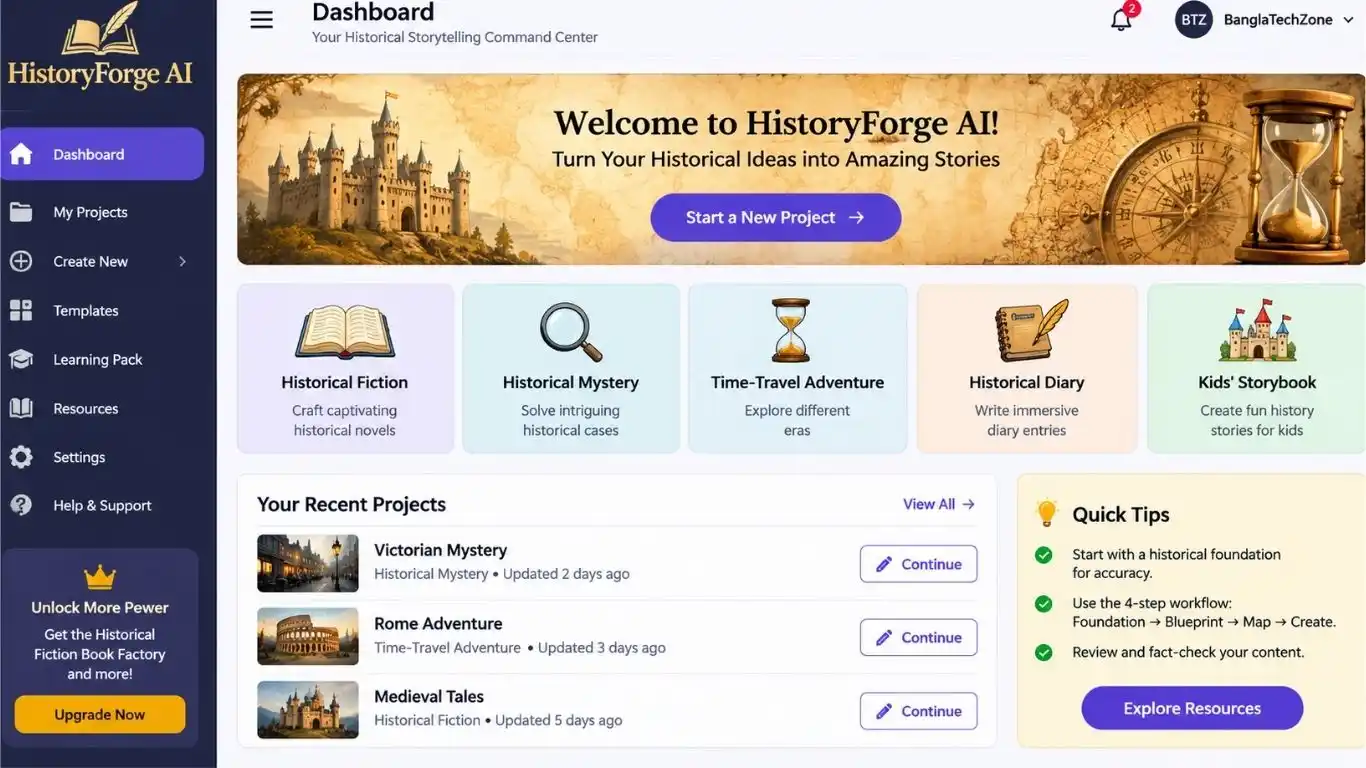
Instead of starting with a blank page, users can establish historical foundations, develop story blueprints, organize project maps, and generate content through specialized creation engines.
But is HistoryForge AI really worth your money? What features does it include? How much does it cost? Are the optional upgrades worth purchasing?
In this detailed HistoryForge AI Review, we’ll explore its features, working process, pricing, OTOs, advantages, disadvantages, and potential use cases to help you make an informed purchasing decision.
Let’s get started!
Looking for another AI-powered content creation tool? Check out our detailed Pin2Profit AI Review to explore its features, pricing, and potential benefits.
HistoryForge AI Review – Quick Overview
Here is a quick overview of the product and its advertised features.
| Product Details | Information |
|---|---|
| Product Name | HistoryForge AI |
| Product Creator | Pintu Bachhar and team |
| Product Type | AI Historical Storytelling Platform |
| Main Purpose | Historical storytelling and project development |
| Creation Modes | 5 specialized engines |
| Core Workflow | Foundation → Blueprint → Map → Create |
| Frontend Launch Price | $17 (advertised launch price) |
| Payment Type | Advertised one-time frontend payment |
| Money-Back Guarantee | 7 days (advertised) |
| Best For | Writers, teachers, parents, students, and content creators |
| Skill Level | Beginner to Advanced |
| Official Access | Check the official offer page |
Note: Prices, features, payment conditions, and promotional terms may change. Always verify the latest information on the official sales and checkout pages before purchasing.
What Is HistoryForge AI?
HistoryForge AI is an AI-assisted historical storytelling and project development platform designed to help users transform creative ideas into organized history-based projects.
Writing historical content involves several important challenges.
You may need to research a particular historical period, understand cultural practices, develop believable characters, maintain chronological consistency, and organize different story elements.
Using a general-purpose AI writing assistant can help with individual writing tasks, but managing an entire historical project often requires additional planning.
HistoryForge AI addresses this challenge through a combination of specialized creation engines and a guided project workflow.
It is designed to help users:
- Establish historical settings and backgrounds.
- Develop story premises and blueprints.
- Organize characters and locations.
- Plan historical mysteries and clues.
- Maintain diary timelines and narrative consistency.
- Create children’s historical stories.
- Generate individual scenes, chapters, and educational materials.
Whether you want to develop a historical novel, create a mystery set in Victorian England, write a time-travel adventure, or prepare educational stories for children, the platform aims to provide a more organized starting point.
Its central concept is straightforward: establish the historical foundation first, plan the project second, and create the content afterward.
Who Created HistoryForge AI?
HistoryForge AI is credited to Pintu Bachhar and the development team.
The product focuses on combining AI-assisted writing with structured historical storytelling workflows.
Rather than presenting itself as a general-purpose AI writing assistant, it concentrates on the specific planning and organizational requirements of history-based creative projects.
Its advertised approach combines historical context, project development, storytelling, and content generation in one environment.
HistoryForge AI Features – What Makes It Different?
One of the main attractions of HistoryForge AI is its collection of specialized storytelling engines and project organization features.
Let’s examine its major advertised capabilities.
1. Five Specialized Historical Creation Engines
HistoryForge AI offers five specialized creation modes designed for different types of historical projects.
These include:
- Historical Fiction Engine.
- Historical Mystery Engine.
- Time-Travel Adventure Engine.
- Historical Diary Engine.
- Kids’ History Storybook Engine.
Each storytelling format has different requirements.
For example, a historical mystery needs suspects, motives, clues, and logical solutions. A children’s history story requires simpler language, age-appropriate explanations, and educational elements.
Separate creation modes are intended to make these projects easier to organize.
2. Historical Foundation Generator
Historical context is essential when developing believable historical stories.
A character living in medieval Europe, for example, would have a very different lifestyle, knowledge, technology, and social environment from someone living in Victorian England.
HistoryForge AI includes a Historical Foundation Generator designed to help establish the historical environment before story creation begins.
It can help organize:
- Historical time periods.
- Geographical locations.
- Everyday lifestyles.
- Cultural practices and social expectations.
- Available technology.
- Historical limitations.
- Character knowledge.
- Environmental conditions.
This provides a structured reference for developing the story.
However, AI-generated historical information should not automatically be considered accurate. Important facts should be checked against reliable historical sources before publication.
3. Foundation → Blueprint → Map → Create Workflow
One of the most important advertised features is its four-stage storytelling workflow.
Instead of immediately generating large amounts of text, users can organize their projects through separate development stages.
Foundation: Establish the historical setting, time period, cultural background, and relevant historical details.
Blueprint: Develop the story premise, characters, tone, central conflict, and creative direction.
Map: Organize the project structure using relevant story maps, timelines, mystery clues, or other planning elements.
Create: Generate individual scenes, chapters, diary entries, mystery clues, or educational content.
This approach encourages users to plan their projects before moving into content generation.
4. Historical Fiction Engine
Historical fiction requires a balance between imagination and historical context.
The Historical Fiction Engine is designed to assist with:
- Character development.
- Plot planning.
- Scene creation.
- Chapter development.
- Historical setting organization.
- Story continuity.
For example, you could develop a fictional story set in ancient Rome, medieval Europe, or Victorian England.
The platform can assist with organizing the creative elements, but writers should independently verify historical details and review the final manuscript.
5. Historical Mystery Case File System
A convincing historical mystery requires more than suspicious characters and unexpected plot twists.
The clues, suspects, motives, and final solution must connect logically.
HistoryForge AI includes a Historical Mystery Case File system designed to help organize:
- Suspects.
- Motives.
- Means.
- Opportunities.
- Clues.
- Red herrings.
- Investigation progression.
- Solution logic.
This can help mystery writers develop a more organized investigation and maintain consistency throughout the story.
Check the Latest HistoryForge AI Deal Here
Other Important HistoryForge AI Features
In addition to the five creation engines, the platform advertises several specialized planning and organizational features.
6. Mystery Spoiler Lock
Mystery writers need to control when important information is revealed.
The Spoiler Lock feature is designed to help keep the mystery solution hidden during the development process.
This can be useful when organizing clues, suspects, and investigation details without revealing the final answer too early.
7. Time-Travel Rule Builder
Time-travel stories can become confusing when the rules change throughout the narrative.
HistoryForge AI’s Time-Travel Adventure Engine is designed to help establish consistent rules and limitations.
Users can organize:
- Time-travel rules.
- Restrictions and limitations.
- Costs and consequences.
- Events that cannot be changed.
- Characters’ knowledge.
- Historical consequences of time travel.
These planning elements can help writers develop more consistent time-travel adventures.
8. Historical Diary Calendar
Historical diary writing requires chronological consistency.
The Diary Calendar feature is designed to help organize entries according to a timeline.
It can help track:
- Entry dates.
- Historical events.
- Personal developments.
- Emotional changes.
- Ongoing conflicts.
- Narrative progression.
This may be particularly useful when developing fictional diaries based on historical periods or characters.
9. Voice Continuity Control
Maintaining a consistent narrator throughout a long diary or storytelling project can be challenging.
HistoryForge AI advertises voice continuity controls designed to help maintain the narrator’s:
- Tone.
- Vocabulary.
- Personality.
- Knowledge limitations.
- Narrative style.
This can help make separate entries feel more consistent with the same character.
10. Kids’ History Storybook Engine
Historical storytelling for children requires a different approach from writing for adult readers.
The Kids’ History Storybook Engine is designed to help create age-appropriate historical stories.
Its advertised capabilities include:
- Vocabulary adjustments.
- Story complexity control.
- Historical explanations.
- Educational questions.
- Learning activities.
- Topic difficulty adjustments.
This may be useful for parents, teachers, and educational content creators.
11. Historical Learning Pack Generation
HistoryForge AI also advertises learning pack generation to help expand historical stories into educational materials.
These may include:
- Historical timelines.
- Quizzes.
- Discussion questions.
- Learning activities.
- Supporting educational content.
These resources can help turn a storytelling project into a more complete learning experience.
All educational materials should be reviewed for age suitability and historical accuracy before use.
12. Fact vs. Invention Transparency
One particularly interesting feature is the distinction between historical information and fictional storytelling elements.
HistoryForge AI is designed to organize content into three broad categories:
- Historical context.
- Plausible reconstruction.
- Creative invention.
This distinction can help writers identify which parts of a story are intended to represent historical information and which are creative additions.
However, labeling something as historical context does not independently prove that it is factually correct.
Reliable references and human fact-checking remain essential.
13. Premise Cards, Character Cards, and Setting Maps
Managing a large historical project can become difficult when several characters, locations, and storylines are involved.
HistoryForge AI advertises organizational resources such as:
- Historical Foundations.
- Premise Cards.
- Character Cards.
- Setting Maps.
- Portable Project Cards.
These resources are designed to help users organize important project information and maintain consistency.
The offer also describes certain core project resources as unlimited. Check the current sales terms for applicable usage conditions.
14. Multiple Project Management
HistoryForge AI supports separate project organization.
According to the product description, individual projects can maintain their own Foundation, Blueprint, Map, and Project Card.
This can be helpful for writers developing multiple historical stories or content creators working on different educational projects.
15. Create Content on Command
Once the historical foundation and project structure are established, users can request specific content.
Examples include:
- Individual story scenes.
- Book chapters.
- Historical diary entries.
- Mystery clue sets.
- Storybook sections.
- Educational materials.
This provides a more structured way to develop individual parts of a project rather than expecting the entire book to be generated in one step.
What Do You Get With HistoryForge AI?
According to the advertised frontend offer, the core package includes access to the following features:
- Five specialized historical creation engines.
- Historical Foundation Generator.
- Foundation → Blueprint → Map → Create workflow.
- Historical Fiction Engine.
- Historical Mystery Case File system.
- Time-Travel Adventure Engine.
- Historical Diary Calendar.
- Kids’ History Storybook Engine.
- Mystery Spoiler Lock.
- Voice continuity controls.
- Historical Learning Pack generation.
- Premise Cards.
- Character Cards.
- Setting Maps.
- Portable Project Card.
- Fact-versus-invention labeling.
- Multiple project organization.
The main attraction is having several history-focused creative workflows organized within one platform.
Check the Latest HistoryForge AI Deal Here
How Does HistoryForge AI Work?
HistoryForge AI follows a guided process designed to help users develop historical storytelling projects step by step.
Here’s how a typical project may be created.
Step 1: Choose Your Creation Engine
First, select the type of historical project you want to develop.
You can choose from historical fiction, historical mystery, time-travel adventure, historical diary, or children’s history storytelling.
Start with a simple idea.
For example:
“A mysterious disappearance in Victorian London.”
Step 2: Generate Your Historical Foundation
Next, establish the historical background.
Organize the time period, geographical location, lifestyle, cultural environment, and other relevant details.
This creates a reference point for your project.
Remember to verify important historical claims independently.
Step 3: Develop Your Project Blueprint
Now organize the story’s premise, characters, tone, conflict, and major creative decisions.
Review and adjust the direction before proceeding.
Step 4: Create Your Project Map
The next stage involves organizing the overall project structure.
Depending on your chosen creation mode, this may involve story maps, mystery clue maps, adventure rules, or diary timelines.
Step 5: Generate Your Content
After completing the planning stages, start creating the content you need.
You might generate a chapter, scene, diary entry, mystery clue set, or educational story section.
Finally, review, edit, fact-check, and prepare the content for your intended audience.
HistoryForge AI Pricing – How Much Does It Cost?
Pricing is an important consideration before purchasing any new AI software.
The advertised HistoryForge AI frontend launch price is $17 as a one-time payment. The promotional materials also show a regular price of $57.
The offer advertises a 7-day money-back guarantee.
However, launch prices and promotional conditions can change. Therefore, the actual price displayed at checkout should always be treated as the final reference.
HistoryForge AI Frontend Deal
The frontend package provides access to the core historical storytelling platform and its five specialized creation engines.
For users who want to explore the platform without immediately committing to an ongoing frontend subscription, the advertised one-time payment structure may be attractive.
My recommendation: Start by evaluating the frontend package against your actual writing needs. You do not necessarily need every optional upgrade.
HistoryForge AI OTOs – Optional Upgrades Explained
HistoryForge AI also offers optional upgrades, commonly known as One-Time Offers (OTOs).
These upgrades are designed to expand specific storytelling capabilities.
The following prices have appeared in promotional and third-party review materials. Some reported prices differ, particularly for OTO 1, so verify the actual checkout amount before purchasing.
OTO 1: Historical Fiction Book Factory
Reported price: $27–$37
This upgrade is positioned around creating longer historical fiction manuscripts.
It may be relevant to writers who want additional tools for developing full-length historical fiction books rather than concentrating only on individual scenes or chapters.
OTO 2: 100 Historical Fiction Worlds
Reported price: $37
This upgrade is described as a collection of historical fiction settings and world-building resources.
It may appeal to writers who regularly need fresh historical environments and story inspiration.
OTO 3: Kids History Book Factory
Reported price: $47
This upgrade focuses on children’s historical book creation.
It may be worth exploring for parents, teachers, educational publishers, and content creators who regularly develop children’s historical materials.
OTO 4: Historical Mystery Vault
Reported price: $67
This upgrade focuses on historical mystery development and related resources.
Mystery writers who want to develop multiple investigation-based stories may find this category relevant.
Are the HistoryForge AI OTOs Necessary?
No. The upgrades are optional.
You should evaluate each upgrade according to your actual requirements rather than purchasing everything automatically.
For example:
- Historical novel writers may investigate OTO 1.
- Creators looking for additional historical settings may consider OTO 2.
- Teachers and children’s book creators may find OTO 3 more relevant.
- Historical mystery writers may be interested in OTO 4.
My suggestion is to start with the frontend and purchase additional upgrades only when their features provide genuine value for your projects.
HistoryForge AI Pros and Cons
No software is perfect. Before making a purchase decision, it is important to understand both its advantages and limitations.
Pros
- Five specialized historical creation engines.
- Structured workflow for developing creative projects.
- Historical foundation planning before content creation.
- Dedicated historical mystery planning system.
- Time-travel rule organization.
- Historical diary calendar.
- Voice continuity controls.
- Children’s educational story creation.
- Learning pack generation.
- Separate project organization.
- Fact-versus-invention labeling.
- Advertised one-time frontend payment.
- Advertised 7-day money-back guarantee.
Cons
- AI-generated historical information still requires independent fact-checking.
- Users must review and edit generated content.
- It is not a replacement for academic historical research.
- The structured workflow may not suit everyone.
- Optional upgrades can increase the overall purchase cost.
- The advertised 7-day refund period is relatively short for evaluating a large project.
- Actual output quality and usability should be evaluated through hands-on testing.
Check the Latest HistoryForge AI Deal Here
Who Should Use HistoryForge AI?
HistoryForge AI may be worth considering for several types of creators.
Historical Fiction Writers
Writers who want to develop historically grounded fictional stories may benefit from its foundation, blueprint, character, and project organization features.
Mystery Story Writers
Creators who enjoy historical investigations can explore the mystery-focused planning tools for organizing suspects, motives, clues, and solutions.
Time-Travel Story Creators
Writers developing time-travel adventures may appreciate the ability to establish consistent rules, limitations, and consequences.
Teachers and Educators
Teachers can explore the platform for developing story-based educational materials, historical timelines, quizzes, and learning activities.
Parents
Parents who want to introduce historical topics to children through creative storytelling may find the children’s storybook engine interesting.
Students and History Enthusiasts
People interested in historical storytelling can use the platform to explore creative ideas and organize their projects.
Digital Content Creators
YouTube creators, bloggers, podcasters, and other publishers may use historical storytelling as inspiration for their content.
However, factual claims should always be verified against reliable sources before publication.
Who Should Avoid HistoryForge AI?
HistoryForge AI may not be the right choice for everyone.
Consider avoiding it if:
- You primarily create modern or non-historical content.
- You need academic-level historical research without independent verification.
- You expect a complete professional book from a single click.
- You dislike structured project workflows.
- You are unwilling to review and edit AI-generated material.
- You want a completely hands-free publishing system.
- You already have a workflow that meets all your historical storytelling requirements.
Understanding these limitations can help you make a more informed decision.
HistoryForge AI vs. Generic AI Writing Tools
You may wonder why you should consider a specialized historical storytelling platform when general AI assistants are already available.
The main difference is the workflow.
| Comparison | HistoryForge AI | Generic AI Writing Tool |
|---|---|---|
| Historical Project Focus | Specialized | General-purpose |
| Historical Foundation | Dedicated workflow | Prompt-dependent |
| Story Planning | Structured blueprint | User-directed |
| Project Mapping | Dedicated planning resources | May require manual organization |
| Historical Mystery Planning | Specialized case system | Prompt-dependent |
| Diary Timeline | Dedicated controls | Manual organization |
| Children’s History Content | Specialized engine | General prompting |
| Project Organization | Separate project resources | Depends on the tool |
General AI writing assistants remain useful for brainstorming, editing, research assistance, and content generation.
HistoryForge AI’s potential advantage is its organized historical storytelling workflow rather than simply generating text.
However, this does not automatically mean it produces better writing or more accurate historical information than every general AI assistant.
Is HistoryForge AI Beginner-Friendly?
The guided workflow is designed to help users move through different project stages.
Beginners can start with a simple idea and gradually develop the historical foundation, blueprint, project map, and content.
This may make the creative process more approachable for people who have never developed a complete historical story before.
However, beginner-friendly does not mean completely automatic.
You will still need to review the output, make creative decisions, improve the writing, and verify historical information.
Does HistoryForge AI Guarantee Historical Accuracy?
No. No AI writing platform should be treated as a guaranteed source of historical truth.
HistoryForge AI advertises tools intended to establish historical context and distinguish historical information from plausible reconstruction and creative invention.
These features may help organize the review process, but they cannot replace reliable historical references, primary sources, academic research, or expert verification.
If you are creating educational resources, historical nonfiction, or content involving sensitive historical events, independent fact-checking is essential.
Is HistoryForge AI Worth It?
After reviewing its advertised features, workflow, pricing, and limitations, HistoryForge AI appears to offer an interesting approach to historical storytelling.
Its main attraction is the combination of five specialized creation engines with a structured project workflow.
Instead of focusing exclusively on text generation, the platform is designed to help users organize historical context, project planning, characters, timelines, and content creation.
The advertised $17 frontend launch price also makes it a relatively accessible option for people interested in exploring its core features.
However, the actual value depends on how frequently you create historical content and whether its specialized workflow matches your requirements.
If you write historical fiction, develop mystery stories, create educational materials, or enjoy history-based storytelling, it may be worth considering.
On the other hand, if you need professional historical research, guaranteed factual accuracy, or completely automated book publishing, you should carefully evaluate its limitations before purchasing.
FAQ-HistoryForge AI
What is HistoryForge AI?
HistoryForge AI is an AI-powered historical storytelling platform designed to help users create and organize historical fiction, mysteries, time-travel adventures, diary projects, and children’s history stories.
How much does HistoryForge AI cost?
The advertised frontend launch price is $17 as a one-time payment. Promotional pricing may change, so check the official checkout page for the current price.
Does HistoryForge AI require a monthly subscription?
The frontend offer is advertised as a one-time payment rather than a recurring subscription. Always verify the current purchase terms before ordering.
Is HistoryForge AI suitable for beginners?
Yes. Its structured workflow can help beginners move from a basic idea to a more organized storytelling project. Editing and research skills are still beneficial.
Can HistoryForge AI create historical fiction?
Yes. It includes a Historical Fiction Engine designed to assist with character development, plot planning, scenes, chapters, and project continuity.
Can I create historical mystery stories?
Yes. Its Historical Mystery Engine includes case organization features for suspects, motives, clues, red herrings, and solution planning.
Can HistoryForge AI create children’s history books?
It includes a Kids’ History Storybook Engine designed to assist with age-appropriate stories, educational explanations, questions, and learning activities.
Does HistoryForge AI guarantee accurate historical information?
No. Its historical foundation and fact-versus-invention features can help organize information, but important details must still be verified using reliable sources.
Are HistoryForge AI OTOs compulsory?
No. The OTOs are optional upgrades. You can evaluate the main package first and purchase additional offers only if you need them.
Is HistoryForge AI worth buying?
It may be worth considering for historical fiction writers, mystery creators, teachers, parents, and educational content developers who can benefit from its specialized workflow.
Can I use HistoryForge AI for multiple projects?
The frontend offer describes separate project organization, allowing users to manage different projects independently. Check the current terms for applicable usage limits.
Does HistoryForge AI replace professional writers or historians?
No. It is an AI-assisted creative tool, not a replacement for professional writing judgment, historical expertise, or independent research.
Final Verdict – Should You Buy HistoryForge AI?
HistoryForge AI is an interesting AI-assisted storytelling platform for creators who want a more organized way to develop historical projects.
Its five creation engines cover several storytelling formats, while the Foundation → Blueprint → Map → Create workflow provides a clear structure for turning ideas into organized projects.
I particularly like the focus on historical foundations, project organization, mystery planning, and children’s educational materials.
Nevertheless, it is important to remember that AI-generated content requires human review, editing, and fact-checking.
My final recommendation: If historical storytelling is an important part of your creative work, HistoryForge AI deserves a closer look.
Start with the frontend package, evaluate its actual capabilities, and consider the optional upgrades only when they match your goals.
Check the Latest HistoryForge AI Deal Here
Affiliate Disclosure
This article may contain affiliate links. If you purchase through one of these links, BanglaTechZone may earn a commission at no additional cost to you.
Our goal is to provide useful product information, explain potential benefits and limitations, and help readers make informed purchasing decisions.
We encourage readers to review the official product details and purchase terms before making a decision.